5 Smart Strategies to Increase Your Micro-SaaS Valuation in 90 Days (and a bonus)


In my experience running Microns.io, I’ve seen so many micro-SaaS startups being acquired for various multiples. Some businesses have sold for 10x multiples, and others have sold for just 1x. The startups fetching higher valuations excel in two areas: customer retention and revenue model optimization.
So I’ve compiled this guide to show you how to boost your micro-SaaS valuation with tweaks you can implement to optimise for these two metrics. Now let’s get right into it.
What drives micro-SaaS valuation?
There are three main micro-SaaS valuation techniques: seller’s discretionary earnings (the best for small businesses), EBITDA (evaluates your profit before taxes), and revenue-based valuation (which factors the revenue generated by the business, not its profits).
While these techniques look at the numbers, finding your micro-SaaS’s valuation transcends numbers. Other factors that show you’re running a scalable engine are brought into consideration. Here are some of them;
- Revenue quality: One of the common mistakes founders make is thinking that revenue is all about how much your startup generates. It’s an indicator of your business’s health. Buyers are evaluating the business’s churn rate, revenue model (recurring or one-time models), highest-selling subscription packages (monthly or yearly), and other factors. Buyers will be happy to pay more for a micro-startup with reliable, predictable growth.
- Customer metrics: Customer metrics aren’t just numbers. They show how your conversion rates, customer acquisition costs (CAC), and lifetime value (LTV) reflect your profitability. Over time, if you’re spending more to acquire customers than your customers are spending in the business, your engine is inefficient. Typically, buyers are looking for businesses doing 3 - 5x their CAC.
- Clean operations: Founder dependency lowers valuation. This is one of the reasons I can’t overemphasise the importance of having a standard operating procedure (SOP). Buyers want an engine that they can run without your oversight. The more removed you are from the business, the more appealing your business becomes. Also, keeping clean financial records and other documents demonstrates that your business is well organised, and this boosts valuation.
- Good user experience: Regardless of whether your product is great and does exactly as you claim, a poor design can impact the way buyers evaluate your product. There are lots of non-technical buyers, and the last thing they want to do is be bothered about tinkering with your UI/UX or hiring a product designer to fix the product.
READ: 8 Signs You’re Ready to Sell Your Business
How to Improve Your Micro-SaaS Valuation
Now we know what impacts your micro-SaaS’s valuation, let’s look at the quick fixes so we can boost your startup’s valuation within the next 90 days.
1. Reduce churn
Unless your business is the next best thing since sliced bread, you’ll definitely experience churn. However, you may agree with me that we both want to keep this value very low. If you have a good acquisition engine, but customers aren’t sticking around long enough, you’ll spend more on acquiring new customers. You don’t want this, nor does a potential buyer.
So the first step to boosting your micro-SaaS valuation is to retain users. Customers churn from your micro-Saas when they’re not getting enough value for their money. That means to reduce churn, you want to offer your customers more value than they’re paying for to keep them happy.
A few things you can do to reduce churn within the next 90 days include;
Establish a high-touch onboarding process: While customers may know what your platform does, they may not understand how to get the best out of it. You can fix this by offering a free webinar or step-by-step training as part of the subscription to show users how to set up the product for success. Giving both old and new subscribers this experience can potentially increase the LTV of customers.
Build sticky features: You’ve got a great product, no doubt. Have you considered adding a couple more features to keep users coming back to always use your product? I’m referring to features that’ll be so good that users will have to think twice before cancelling.
For example, think about an email marketing platform: it’ll be difficult to stop using your current platform because your business is ingrained in it, and the thought of migrating to another platform might just be exhausting.
Offer expert services: We all want results, don’t we? Your customers want to be successful, and they’ll be willing to pay for add-on expert services to get the most out of your micro-SaaS product in as little time as possible. Google does it. HubSpot does it. All the big SaaS companies you know offer services, and they make a lot of money doing it.
Teach customers how to use your product: As established, many customers churn not because the product isn’t good enough, but because they don’t know how to use the product. Create resources to educate your customers on how to get maximum value from your products.
Imagine using an email tool only for sending emails without knowing you can segment audiences, automate workflows, score leads, or build landing pages/forms with it. That’s massive underutilisation, and you’ll most likely stop using the product when you find a cheaper alternative. Help your customers graduate from basic level usage to pro users.
Improve upon the cancellation workflow: People cancel their subscription for various reasons: it could be a pricing issue, poor UX, or confusion navigating the UI. Ethically, it should be easy for users to cancel their subscription. However, you can turn the process into a funnel to learn more about your customers.
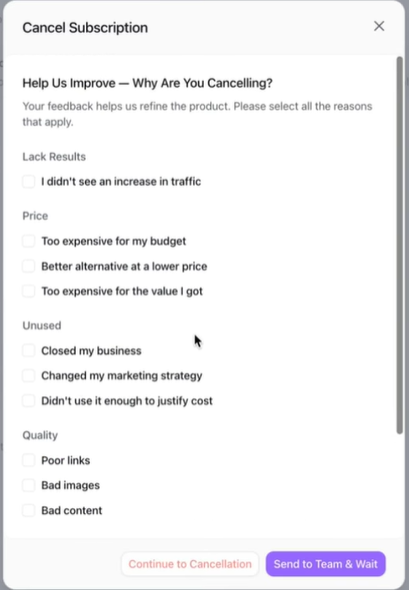
You could ask a question to get feedback about their reason for cancellation, or take it a step further to request that they book a call to discuss their reason.

While you may lose the customer, it’ll help you improve the product for other users to reduce churn. Chances are that if a user is experiencing an issue, other users may be experiencing the same issue.
Get feedback from ex-users: Regardless of whether or not you get responses from the users who have cancelled, you could reach back out to them to get feedback and try to win them back with an incentive.
2. Increase user LTV
Once you’re done reducing churn, the next step to improving your micro-startup’s value in the next 90 days is to find ways to increase the LTV/CAC ratio of customers. Here are a few ways I’ve found helpful in achieving this;
Review your pricing: If you’re having difficulty retaining customers, there’s a decent chance you’ve got a pricing issue. Promote discounts to customers to encourage them to switch to an annual plan. This way, you’re getting revenue upfront. Buyers love to see that you’re retaining your customers over year-long deals, and you’ll be in a good position when you enter negotiations.
Also, rather than basing your price on competitor rates, you could review your pricing to a value-based model to justify the ROI of using your software. You could also offer tiered pricing to meet the needs of different customers. You want to stay away from lifetime deals as much as possible: this deters buyers.
Lower CAC: There are a couple of low-cost ways to acquire more customers. One of them is co-marketing with partners to deliver webinars and co-branded content.
I’ve launched an affiliate program to get more customers. You can do this or offer incentives, such as a percentage of sales revenue gotten through their link, extended subscription periods, or access to premium features.
Additionally, content marketing and reviewing your ad campaigns to end unprofitable campaigns and channels are great ways of lowering customer acquisition costs.
Improving profit margins: You can boost your micro-startup’s valuation by growing account value. That means upselling customers to premium plans or cross-selling them to complementary services. Offer these when customers have reached certain milestones, and it’ll make sense for them to be upgraded. As stated earlier, you could offer to help customers with technical setup and account management.
3. Diversify your customer base
As a micro-SaaS founder, it’s unlikely that most of your revenue is concentrated on a handful of enterprise customers. But if that’s the case, buyers will see your business as risky. To fix this, design your marketing campaigns to target small to mid-sized prospects.
Similarly, having your customers come from one traffic source is risky. What happens when the platform makes changes? Ideally, you want to have a healthy balance of paid and organic channels. However, you want most of your customers to primarily come through organic channels like SEO and email marketing because it’s easier for people to trust you through your organic marketing. Also, your ads will be cheaper as people already know you and will be more ready to engage with your ads.
You can also build in public by creating posts and reels on X, LinkedIn, and Instagram about your solution. Concentrate on giving value with your content rather than selling to build trust. Create case studies to show that your product works and that users are getting results. Also, consider collaborating with micro-influencers in your niche to get more signups.
4. Streamline operations
Earlier, we cited clean operations as a driver for micro-SaaS valuation. The more standardized your operations are, the more valuable your business will be to buyers. A few things you can do over the next 90 days are to create standard operating procedures (SOPs) and keep proper documentation. You can have multiple SOPs for different business functions and operations. This way, it’s easy to pass on your duties to someone else without much handholding.
Additionally, maintaining accurate and up-to-date financial records is essential. Don’t wait till you’re ready to sell your startup to start compiling these. Other documentations you want to keep are your source code, contracts, etc. If you haven’t been keeping records of third-party contracts and employee (or freelancers) contracts, this is your cue to get those in place. Also, a messy codebase will put off technical buyers. Ensure you document the deployment process, run security audits to fix vulnerabilities, fix bugs, update dependencies, and add comments to complex functions.
5. Automate operations
Another thing equally as good as standardising operations is automating them. This will save you and the buyer’s time. The less time buyers have to spend on repetitive tasks, the more appealing your business will be.
You can automate the onboarding process rather than manually repeating it for every customer. Other tasks, such as basic customer support, can also be automated to free up your time. Track the time savings to show buyers the impact.
Bonus: Clarify your product’s positioning
The expectation customers place on your micro-SaaS product depends on your messaging. If you claim your product helps users achieve a goal, they’ll expect that value, and will be dissatisfied if the expectations aren’t met. To strengthen your product positioning, specify what it does rather than making sensational claims. Also, engage with users early in their journeys to find out if they’ve got issues using your product. Then improve upon the product based on user feedback.
READ: How to Buy A YouTube Channel
90-day Framework to Boost Your Micro-SaaS Valuation
Now that we know all the strategies we can deploy to improve your business’s valuation, let’s consolidate all these into a 90-day plan.
Phase 1 (Day 1 - 30): Data and value optimization
The objective of this phase is to fix the "leaky bucket" by reducing churn and making your metrics reflect a stable, investable asset.
Audit metrics: If you haven’t already, track and analyse your revenue metrics such as MRR, ARR, Gross/Net Retention, and CAC.
Educate users: Many users churn when they don't see immediate value, so focus on improving your onboarding sequence by offering a free webinar or step-by-step training to help users reach the "wow moment" early.
Price based on value: Review your pricing and create a tiered pricing model so people can pay based on the value they need.
Review the cancellation workflow: Add a questionnaire to get feedback on why users cancel their subscriptions.
Promote annual pricing: Annual plans reduce churn and improve cash flow, making your company significantly more attractive to buyers. Offer discounts to encourage the switch.
Phase 2 (Days 31 – 60): Revenue acceleration
The objective of this phase is to demonstrate that your growth is repeatable and not just a one-time result.
Release more features: To ensure users are getting value for their money, release sticky features to keep users on your platform. Also, improve upon features or release new features based on user feedback.
Build an affiliate program: Set up a commission-based program for users to refer others. One good affiliate can create a consistent, low-CAC revenue stream.
Formalize documentation: Create clean, accessible, and comprehensive SOPs and documentation. This makes your business look professional and reduces future support dependency.
Phase 3 (Days 61–90): Scaling & Exit Positioning
The objective is to show that the business can run without you and is ready for acquisition.
Automation: Replace yourself. Automate onboarding, customer support (AI bots), and lead generation. Hire freelancers to handle marketing. Buyers pay for assets, not jobs.
Strengthen SEO and authority: Publish 10+ SEO-optimized, in-depth articles or case studies in your niche. Begin building your personal brand and create high-value content on social media to build trust and funnel organic traffic to your website.
Create a clean data room: Organize your metrics, user data, and revenue stats in a tool like Notion or a spreadsheet, ready for due diligence.
Focus on the "Rule of 40": Target a combined growth rate and profit margin exceeding 40%. This has recently become the standard by which SaaS investors measure success. It can also be applied to micro-SaaS startups.
Final thoughts
If you plan on selling your business, there’s no better time than now to boost your business’s valuation. You can also list your startup on our marketplace: this guide will show you how to do so for free. There are lots of interested buyers who’d be delighted to learn about your business. You’ll get competitive offers, and you’re likely to sell your business very fast, as a lot of the businesses are sold within 30 days.

Profitable startups straight to your inbox