AI Comics Generator
Web app
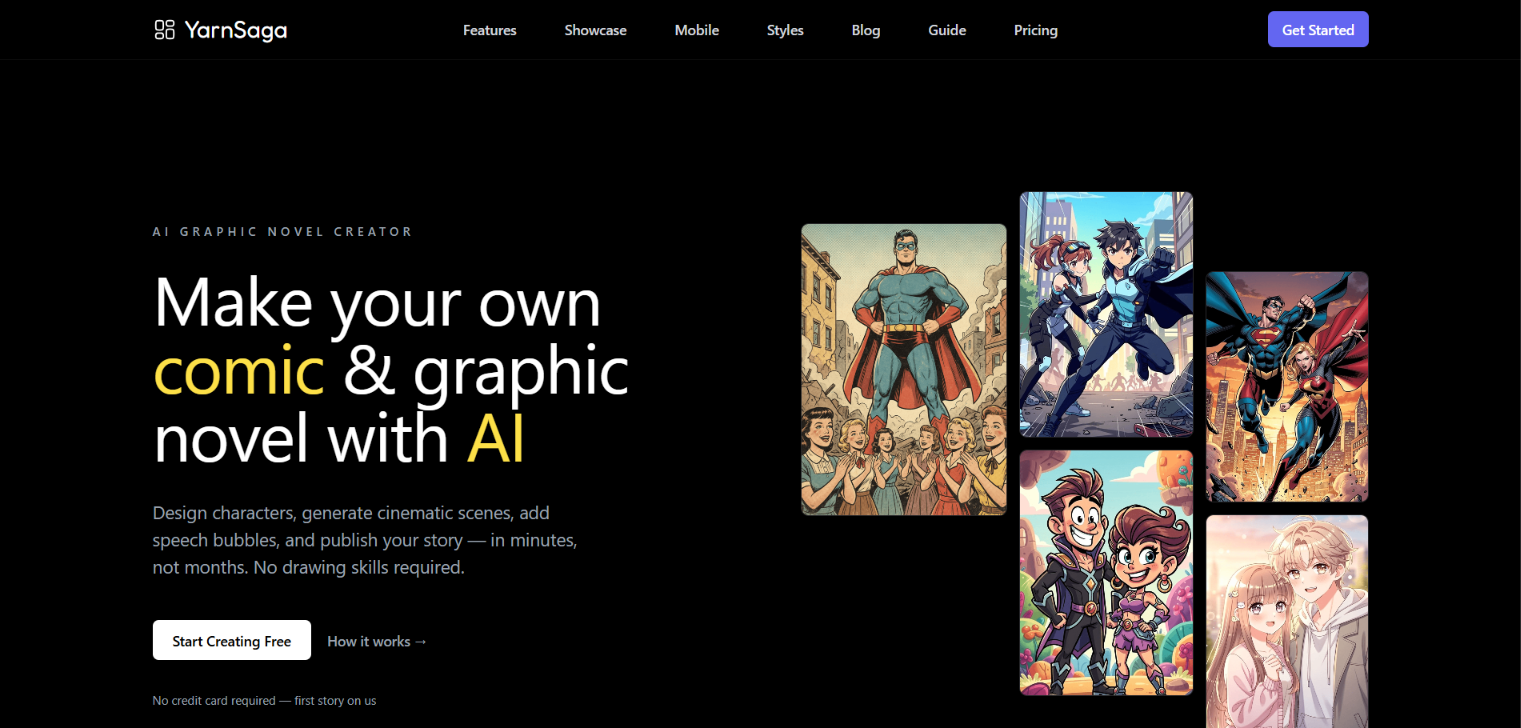
AI comic studio that turns written stories into print-ready graphic novels, with consistent characters across the whole book
Published on
August 25, 2026

$10,000
Asking Price
Main Metrics
$1,327
ARR
22
Customers
2026
Launched
$10,000
Asking Price
Already Sold
Main Metrics
$1,327
ARR
22
Customers
2026
Launched
Overview
<p><b>Startup description</b></p><p>My platform turns written stories into finished comics and graphic novels. A user describes their characters — or uploads a selfie — writes their scenes, and the platform generates illustrated panels that keep the same characters, art style and props consistent across the entire book. A browser-based editor adds speech bubbles, covers, effects and page layouts, and exports print-ready pages. On mobile there is a separate one-page flow: upload a photo, pick a style, and become the hero of your own comic in a few minutes.</p><p>I built it because generic AI image tools fail at exactly the thing storytelling requires — the hero looks like a different person in every picture. Solving character consistency is the core of the product and the reason customers come back. It launched in early 2026 and has been live and taking payments since April 2026.</p><p><b>Key highlights</b> (as of late August 2026):</p><ul>
<li>Revenue run-rate: ~$300/month over the last three months (~$3.6K annualized). Total revenue to date: $1,327 from 45 orders.</li>
<li>Profit: roughly break-even. All acquisition is organic, so there is no ad spend; the dominant variable cost is free trial credits given to new users, which functions as the acquisition budget.</li>
<li>Gross margin on generation: ~43% — every AI call is logged with its exact cost, so margins are measured, not estimated. On paid credits alone the margin is substantially higher; free credits are what pulls the blended number down.</li>
<li>Churn: not applicable — there is no subscription. Credit packs are one-time and never expire, so nothing cancels. The equivalent metric is repeat purchase: 41% of paying customers have bought more than once, and 63% of all revenue comes from repeat purchases.</li>
<li>LTV: ~$60 average per paying customer; largest single customer $514 across 6 purchases.</li>
<li>CAC: effectively $0 — no paid advertising has ever been run.</li>
<li>Users: 805 registered accounts, 386 of whom actually spent credits and generated work, producing 635 stories and ~7,000 generations. 22 have converted to paying customers.</li>
<li>Traffic: ~1,600 sessions in the last 28 days — 44% direct, 44% organic search, 8% from AI assistants. ~20,700 Google impressions over the same period.</li>
</ul>
<p><b>Team</b></p><p>One person: me. I built the entire platform end-to-end and run it alone — product, engineering, design, marketing and support. There are no employees, contractors or agencies, and therefore no payroll, notice periods or people-related liabilities to transfer. Operating the business takes a few hours a week; everything beyond that is discretionary growth work.</p><p><b>Tech Stack</b></p><ul>
<li>Front end: Vue 3 + Vite. Two applications — a marketing site with static generation for SEO, and the editor app.</li>
<li>Back end: Node.js / Express (ESM), MongoDB for data.</li>
<li>Infrastructure: managed hosting for the front end, managed MongoDB, S3-compatible object storage with CDN for generated images, real-time push for job progress, transactional email.</li>
<li>Payments: Stripe (primary), with a second processor still wired up.</li>
<li>Generation pipeline: an asynchronous job queue with webhooks, automatic retries and crash recovery; every AI call is logged with model, token usage and exact dollar cost.</li>
<li>AI layer: the product uses several of the most advanced image and language models available today, behind an abstraction layer that lets any model be swapped or added per art style without touching product code — a deliberate choice, since the model landscape shifts every few months. The specific providers, model routing and prompt architecture are the core know-how of the business and are disclosed to a serious buyer under NDA.</li>
<li>Admin: a built-in admin panel with revenue and cost dashboards, active-user monitoring, a story viewer, a model testing lab and a support ticket system.</li>
</ul>
<p><b>Marketing and growth</b></p><p>Everything has been organic. The main activities:</p><ul>
<li>SEO content — a library of roughly 175 indexed pages: guides, art-style pages, use-case pages, genre pages and competitor comparisons, including 31 blog posts. This is the primary acquisition engine and now produces ~20,700 impressions per month.</li>
<li>AI search optimization — content structured so AI assistants can cite it. This now delivers about 8% of all traffic at zero cost and is the fastest-growing channel.</li>
<li>Mobile flow — mobile was about a quarter of traffic and converted at nearly nothing because the desktop editor is unusable on a phone. A phone-native "put yourself in a comic" flow shipped in July 2026 to open that segment.</li>
<li>Social — accounts on Instagram, X and Pinterest, publishing finished comics made on the platform.</li>
<li>Monetization work — a redesigned paywall, recovery coupons for users who hit the wall, and a geo allowlist for free trial credits that removed spend on markets which never produced a single purchase.</li>
</ul>
<p><b>Revenue and profit</b></p><ul>
<li>Total revenue since the first sale in April 2026: $1,327 across 45 orders from 22 paying customers.</li>
<li>Monthly: April $110 · May $320 · June $224 · July $355 · August $318 (first 24 days).</li>
<li>MRR run-rate ≈ $300; ARR run-rate ≈ $3.6K.</li>
<li>No subscription revenue — all of it is one-time credit pack purchases from $6 to $299, with credits that never expire.</li>
<li>Repeat purchase: 9 of 22 customers (41%) bought more than once; 63% of revenue is repeat.</li>
<li>Retention / churn: no cancellations are possible; the retention signal is customers returning to top up when they start a new story.</li>
<li>Costs: AI generation runs about $180–250/month at current volume, plus a small fixed infrastructure cost. There is no marketing spend, no salaries and no debt.</li>
<li>Profitability: approximately break-even today. The gap between break-even and profit is entirely free trial credits — the cost of acquiring users. Restricting free credits to converting markets in July 2026 already removed roughly a third of that burn without reducing paid conversions.</li>
</ul>
<p><b>Return on investment</b></p><p>This is an early-stage asset, so the payback case is growth-based rather than cash-flow-based. Three levers determine the payback period, and all three are unexercised:</p><ul>
<li>Conversion. About 7% of active users become paying customers today, with the paywall timed to when free credits run out. Better packaging and paywall timing move revenue with no new engineering.</li>
<li>Click-through. The site already earns ~20,700 monthly impressions but converts a small fraction into clicks. Title and meta work on pages that already rank multiplies traffic without producing new content.</li>
<li>Paid acquisition. Never tested. Unit economics are measured per generation, so a buyer can calculate exactly what they can afford to pay per customer before spending a dollar.</li>
</ul>
<p>A buyer who does nothing keeps a break-even asset with a real product and organic traffic. A buyer who works the funnel is compounding on infrastructure that is already built and paid for — the expensive part (the consistency pipeline, the editor, the content library) is done.</p><p><b>Startup assets</b></p><p>Everything below transfers with the sale:</p><ul>
<li>Domain .com plus the app and API subdomains.</li>
<li>Full source code — three repositories (marketing site, editor app, API/backend), with architecture documentation, a maintained changelog and written specs for the generation pipeline.</li>
<li>Database with 805 registered users, 635 stories and ~7,000 logged generations, including complete per-call cost history.</li>
<li>22 art styles configured, 15 live — each individually tuned and validated, with cover art and prompt configuration.</li>
<li>SEO content library — ~175 indexed URLs including 31 blog posts, art-style pages, use-case pages, genre pages and competitor comparisons, with existing Google rankings and AI-assistant citations.</li>
<li>Full editor product — canvas editor with speech bubbles, covers, effects, page layouts and print-ready export, plus a mobile one-page flow and installable PWA.</li>
<li>Admin panel — revenue and cost dashboards, active user monitoring, story viewer, support ticket system and a model testing lab.</li>
<li>Payment infrastructure — Stripe account configuration with 9 credit pack products and coupon system, ready to transfer.</li>
<li>Analytics and search accounts — Google Analytics, Google Search Console, Bing Webmaster Tools, IndexNow integration.</li>
<li>Social accounts — Instagram, X and Pinterest.</li>
<li>Email infrastructure — transactional email templates, a newsletter system and a subscriber audience.</li>
</ul>
<p><b>Risks</b></p><p>Stated plainly, with what mitigates each:</p><ul>
<li>Revenue is small and concentrated. 22 paying customers, and the top customer is ~39% of lifetime revenue. This is early-stage scale, not dependency — these are individual one-time purchases with no contracts, so no recurring revenue is at risk. Concentration falls as volume grows, and order count has been rising month over month.</li>
<li>AI model dependency. The product calls third-party image models whose pricing and availability can change. Mitigated by an abstraction layer that lets any model be swapped per art style without product changes, and by per-call cost logging that makes a pricing change visible immediately. A previous provider outage is what prompted this design.</li>
<li>Competition. Anyone can call the same models. What is hard to copy is the consistency pipeline, the editor, the tuned style library and the search authority — a year of accumulated work rather than a weekend clone.</li>
<li>Key-person risk. I am the only person who has touched the codebase. Mitigated by a conventional JavaScript stack any full-stack developer can run, in-repo documentation, and a transition period I'll provide as part of the sale.</li>
<li>Break-even economics. The business does not currently throw off meaningful profit. The cost driver is free trial credits, which is a lever a buyer controls directly — the geo allowlist already proved it can be tightened without hurting paid conversion.</li>
</ul>
<p><b>Summary</b></p><p>You are buying a finished product with a solved hard problem, real customers and a working acquisition channel, at a price that reflects early-stage revenue rather than the cost of building it.</p><p>The hard part is done. Character consistency across a full graphic novel took months of iteration to get right, and it is what makes the product usable rather than a toy. On top of it sits a complete editor — bubbles, covers, layouts, print export — a tuned art-style library, a mobile flow, a metered cost model where every generation's margin is known, and roughly 175 indexed pages that already rank in Google and get cited by AI assistants.</p><p>The economics are honest and measurable: zero acquisition cost to date, 41% of paying customers buying more than once, 63% of revenue from repeat purchases, and per-generation costs logged to the cent so a buyer can model paid acquisition before spending anything.</p><p>What is missing is distribution, not product. No ads have ever been run, conversion has never been seriously optimized, and the largest consumer angle — personalized comics as gifts — is supported by the product but barely marketed. That is the opportunity: the expensive, uncertain part is built and running, and what remains is the part where money reliably buys growth.</p><p>✅ $1,327 TTM revenue</p><p>✅ 22 customers</p><p>✅ Business model: Credits</p><p>✅ Built with Express.js, Digital Ocean, Vue.js</p>
$1,327
Annual Revenue
22
Number of Customers
Expenses
Fixed monthly operating costs: $91.51.
• Servers (API + app): $56
• Managed MongoDB: $30.51
• Object storage + CDN: $5
• Transactional email: $0 (free tier)
• Marketing site hosting: $0 (free tier)
• Domain: ~$15/year
• Marketing, salaries, contractors, debt: $0
AI generation is not an operating expense — it is cost of goods sold, incurred only when a user generates, and priced into the credit they spend. Every call is logged with its exact cost, so margin is measured per generation rather than estimated.
Business Model
One-time credit packs, no subscription. Free credits to try, then packs from $6 to $299 (down to ~$0.75/credit); credits never expire. Stripe checkout, pay-as-you-go, ~43% margin measured per generation.
Target Audience
Indie storytellers, fan-fiction and hobby writers, tabletop RPG players — plus consumers making personalized comics as gifts. Mostly US, Canada, UK and Western Europe.
Asking Price Reasoning
Priced on the asset, not the revenue: a finished product with the hard problem solved, a full editor, and ~175 indexed pages already ranking. Fixed costs $91.51/mo, no debt, no team, and paid acquisition never tested — every growth lever is untouched.
Reason for Selling
I built it from idea to a live product with paying customers. What's left is distribution and growth marketing, not building — and that's not where I want to spend the next year. It runs itself day to day, so it deserves an owner who'll push it.
Growth Opportunity
Three untested levers: conversion (7% of active users pay today — paywall timing and packaging are unoptimized), search CTR (~20,700 monthly impressions converting into few clicks, fixable on pages that already rank), and paid acquisition, which has never been tested.
30 days free support from seller
Competitors
Canva, Pixton, AI Comic Factory, ComicsMaker.ai, Dashtoon, plus general-purpose AI tools people improvise with (Midjourney, Leonardo, ChatGPT image generation). Canva and Pixton give you layout but no consistent AI characters.
Tech Stack
Stripe, Express.js, Digital Ocean, Vue.js, MongoDB.
Traffic Metrics

Revenue Metrics

How it works

$10,000
Asking Price
Already Sold

Main Metrics
$1,327
ARR
22
Customers
2026
Launched

Profitable startups straight to your inbox
Join 10,000+ entrepreneurs and investors looking for their next startup acquisition opportunity.
Oops! Something went wrong while submitting the form.