Expense Tracker iOS App
Mobile app
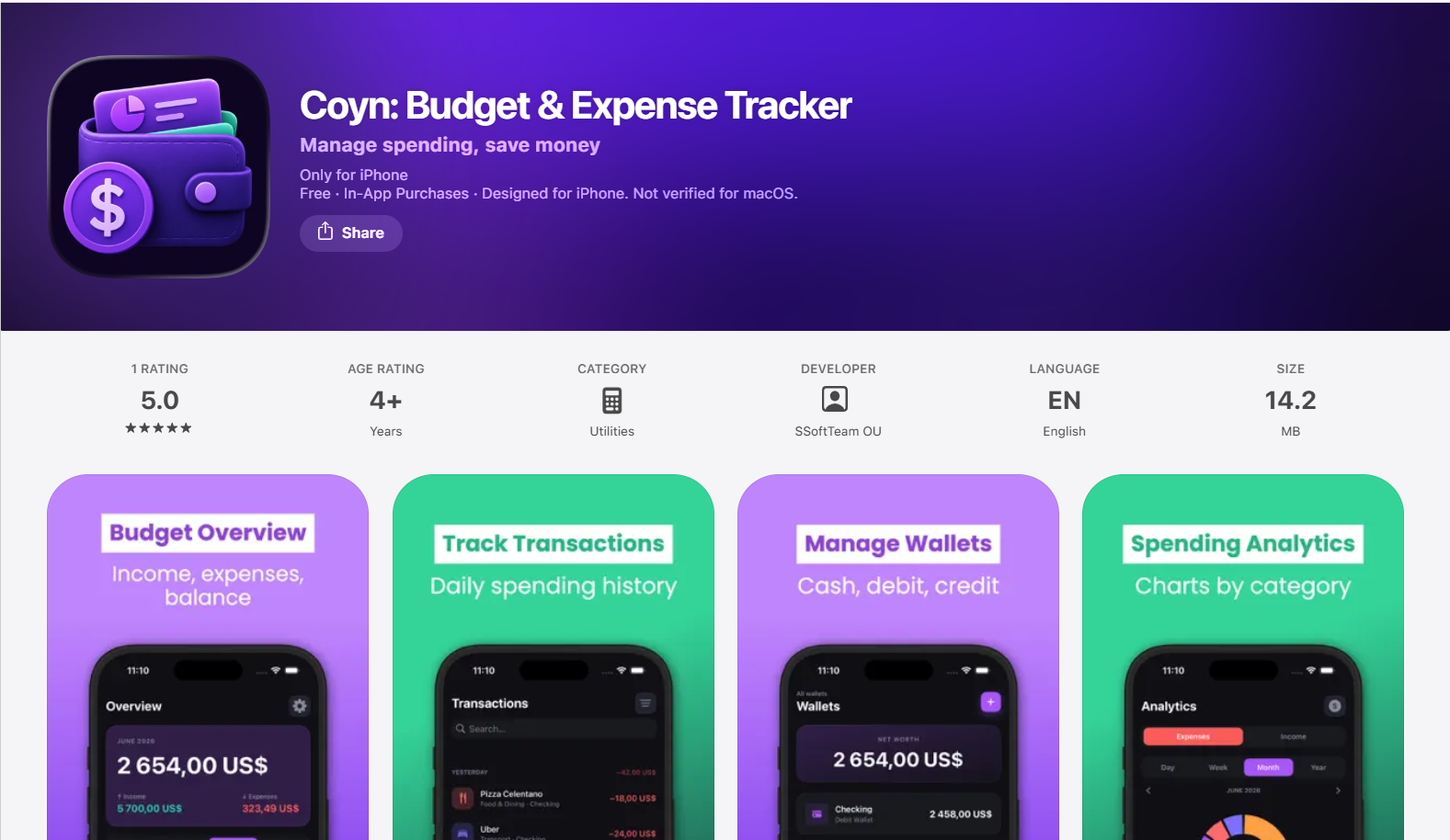
Privacy-focused iOS app that helps users track expenses, manage budgets and wallets, and build better financial habits
Published on
August 20, 2026

$1,200
Asking Price
Main Metrics
$35
ARR
1
Customers
2026
Launched
$1,200
Asking Price
Already Sold
Main Metrics
$35
ARR
1
Customers
2026
Launched
Overview
<p><b>Startup description</b></p><p>My app is a privacy-focused iOS budget and expense tracker that helps users record income and expenses, create custom categories, manage multiple wallets, and understand their spending through reports and charts.</p><p>The app was created as a simple alternative to complicated personal finance tools. It requires no registration, and users’ financial data remains on their devices. The app was published on the App Store on June 12, 2026, and monetizes through auto-renewable Premium subscriptions.</p><p><b>Key highlights</b></p><p>• Total revenue to date: $35, generated in July 2026</p><p>• Current MRR: $35 based on the only monetized month</p><p>• Annual revenue and profit: Not yet meaningful due to the recent launch</p><p>• Operating expenses: $0, excluding standard Apple Developer membership and domain renewal</p><p>• CAC, LTV, churn, and retention: Not yet statistically meaningful</p><p>• Monetization: Weekly, monthly, and annual Premium subscriptions</p><p>• Native iOS product built with Swift and UIKit</p><p>• No backend, servers, external database, or paid APIs</p><p>• No daily operational workload or dedicated staff required</p><p>• Live website, personal finance blog, and domain included</p><p><b>Team</b></p><p>The app does not require a dedicated full-time team. The product can be managed by a single owner who oversees the App Store listing, subscriptions, customer support, product strategy, and marketing.</p><p>An iOS developer is only required when the owner wants to release compatibility updates, fix issues, or add new features. There are no daily technical operations or backend systems to maintain.</p><p><b>Tech stack</b></p><p>The iOS application is built natively with Swift and UIKit. The current version supports iOS 17 and later.</p><p>The app does not use a backend or external database. User transactions and financial information are stored locally on the device, reducing operating costs and simplifying privacy compliance.</p><p>Premium access is monetized through Apple’s in-app subscription infrastructure. The project also includes a lightweight marketing website with landing, support, legal, and personal finance blog pages.</p><p><b>Marketing and growth</b></p><p>Growth activities have so far focused on publishing the App Store listing and establishing an owned website and blog. Marketing has remained limited and exploratory, and no acquisition channel has yet been scaled.</p><p>The app generated $35 during its first monetized month, providing initial proof that users are willing to pay. However, there is not yet enough data to establish a reliable CAC, LTV, retention, or churn rate.</p><p>The main growth opportunities for a new owner include:</p><p>• Improving App Store Optimization and keyword coverage</p><p>• Localizing the app and App Store listing</p><p>• Testing Apple Search Ads and other paid acquisition channels</p><p>• Developing the existing blog as an SEO channel</p><p>• Creating personal finance content for social media</p><p>• Optimizing onboarding, subscription pricing, trials, and the paywall</p><p>• Adding savings goals, recurring transactions, cloud sync, and additional analytics</p><p><b>Revenue and profit</b></p><p>The app was launched on June 12, 2026, and generated $35 in revenue during July 2026. July is the only revenue-generating month to date, so annual revenue, ARR, profit, churn, CAC, and LTV cannot yet be calculated reliably.</p><p>The product has no backend, hosting, database, paid API, or staff expenses. Revenue is subject to Apple’s standard App Store commission, while the only other routine costs are the Apple Developer Program membership and domain renewal.</p><p>Because the app has a short operating history, it should be evaluated as an early-stage product and growth opportunity rather than an established cash-flow business.</p><p><b>Return on investment</b></p><p>A fixed payback period cannot be predicted from the current financial history and will depend on the acquisition price and the buyer’s ability to grow downloads and subscription revenue.</p><p>The low operating cost means that additional subscription revenue can provide a strong contribution margin after Apple’s commission. A buyer with experience in ASO, paid user acquisition, subscription optimization, localization, or personal finance content can pursue payback by increasing installs, improving trial-to-paid conversion, and extending subscriber retention.</p><p><b>Startup assets</b></p><p>• 1 live iOS application published on the App Store</p><p>• 1 complete Swift/UIKit source code project</p><p>• 1 existing App Store listing with metadata and screenshots</p><p>• Existing weekly, monthly, and annual subscription configuration• 1 complete marketing website</p><p>• 1 domain & website</p><p>• Existing support, privacy policy, terms, and blog pages</p><p>• Current branding and visual assets used by the app and website</p><p>There is no backend user database because the app does not require accounts and stores users’ financial information locally on their devices.</p><p><b>Risks</b></p><p>The primary risk is the app’s short operating history. Revenue, retention, churn, LTV, and acquisition economics have not yet been validated at scale.</p><p>The personal finance category is competitive, and paid acquisition may be unprofitable without careful ASO, paywall, pricing, and retention optimization. The product is also dependent on Apple’s App Store policies and requires occasional updates to remain compatible with future iOS versions.</p><p>These risks can be reduced by testing marketing campaigns with controlled budgets, implementing stronger analytics, improving onboarding and subscription conversion, localizing into additional markets, and regularly maintaining App Store compliance.</p><p><b>Why buy</b></p><p>My app gives the buyer a live and monetized iOS product without the time and expense of designing, developing, reviewing, and publishing a new app from scratch.</p><p>The product already includes native source code, subscription infrastructure, an App Store presence, a complete website, a relevant domain, and supporting content. Its backend-free architecture keeps operations simple and inexpensive, while its early stage leaves significant room for a buyer with stronger distribution, marketing, or product development capabilities.</p><p>✅ $35 TTM revenue</p><p>✅ 1 customer</p><p>✅ Business model: SaaS</p><p>✅ Built with Swift, UIKit</p>
$35
Annual Revenue
1
Number of Customers
Expenses
No additional expenses required.
Business Model
Coyn uses a free-to-download subscription model, with Premium priced at $7.99 weekly, $9.99 monthly, or $39.99 annually.
Target Audience
iPhone users seeking a simple, privacy-focused way to track expenses, manage budgets and improve their financial habits.
Asking Price Reasoning
The price reflects a complete native iOS app with source code, active subscriptions, an approved App Store listing, early revenue, and an included website and domain.
Reason for Selling
We are reallocating our resources to other products in our mobile app portfolio and believe this app would benefit from an owner focused on scaling it.
Growth Opportunity
Grow through ASO, localization, paid acquisition, SEO content, and onboarding and paywall optimization.
30 days free support from seller
Competitors
Main competitors include YNAB, Monarch Money, PocketGuard, Buddy, Spendee, and Wallet by BudgetBakers.
Tech Stack
Swift, UIKit.
Traffic Metrics

Revenue Metrics

How it works


Profitable startups straight to your inbox
Join 10,000+ entrepreneurs and investors looking for their next startup acquisition opportunity.
Oops! Something went wrong while submitting the form.