Precision Measurement Training App
Mobile app
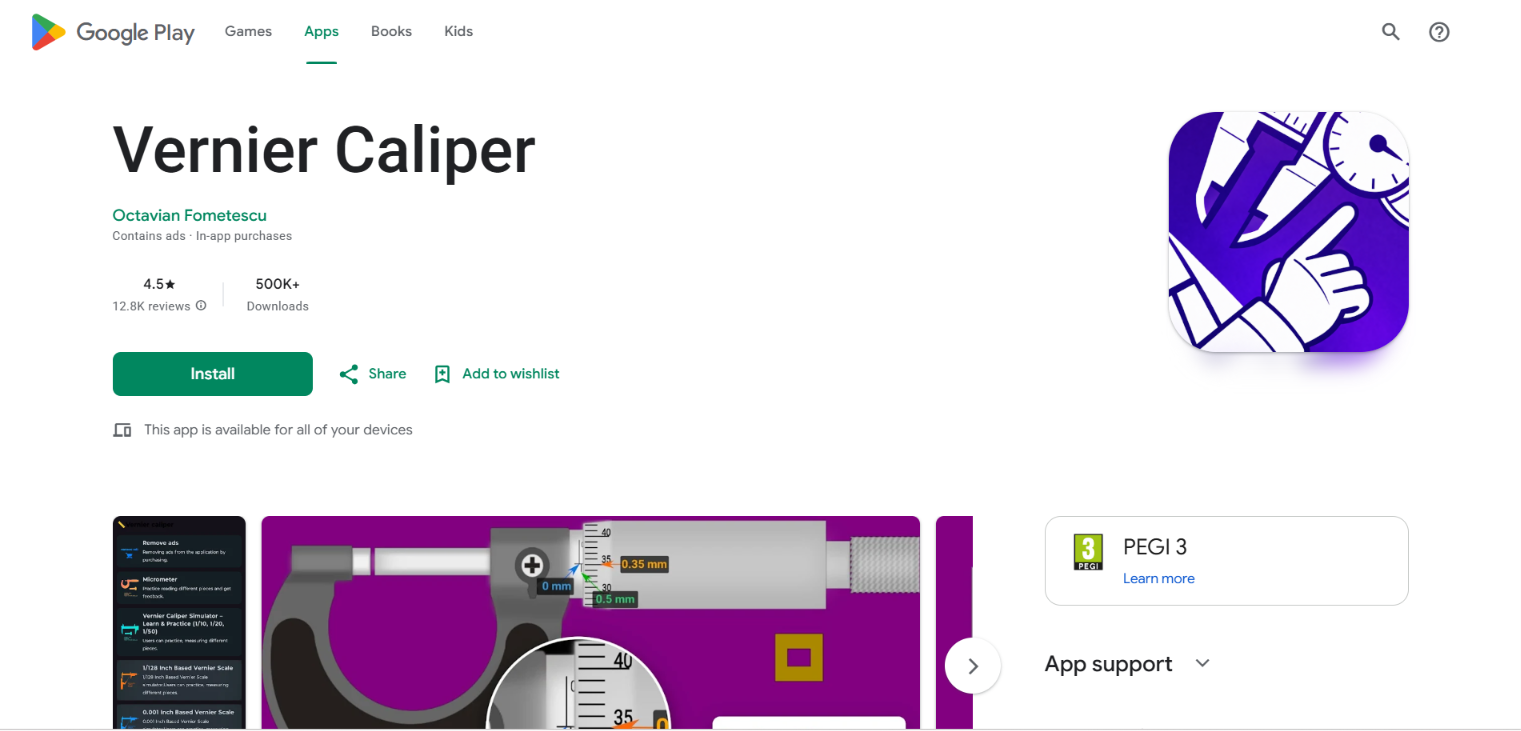
Android app providing interactive training on vernier calipers, micrometers, and other technical measuring instruments
Published on
August 11, 2026

$18,000
Asking Price
Main Metrics
$1,580
ARR
50
Customers
2019
Launched
$18,000
Asking Price
Already Sold
Main Metrics
$1,580
ARR
50
Customers
2019
Launched
Overview
<p><b>Startup description</b></p><p>My product is an established Android educational application focused on precision measurement, metrology and technical training.</p><p>The proposed acquisition can also include the other app, a closely related educational application focused on metric caliper and micrometer training.</p><p>Together, the two applications form a complementary Android educational portfolio.</p><p>I originally created it to make precision-measurement training more interactive and accessible on Android. Over time, it evolved from a relatively simple simulator into a mature educational application covering multiple precision-measurement instruments, guided practice, testing and animated measurement workflows.</p><p>My app covers metric and imperial vernier training, dial and digital calipers, metric and imperial micrometers, vernier bevel protractor and other technical measurement exercises.</p><p>The other app has a different and complementary role. It focuses on metric vernier caliper and micrometer training and adds classroom-oriented functionality such as step-by-step explanations, testing, Teacher Mode, exercise generation, PDF/HTML educational material generation, image-pack generation for worksheets and complementary web access.</p><p>Both applications have recently undergone substantial modernization toward native Android implementations. Most simulation and educational logic runs directly on-device, keeping recurring infrastructure requirements very low.</p><p>The two applications have approximately 959,000 lifetime installs combined and an established international Google Play audience. Growth has historically been predominantly organic rather than driven by paid advertising.</p><p><b>Key highlights</b></p><p>• Approximately 959,000 combined lifetime installs.</p><p>• The main app: approximately 778,000 lifetime installs.</p><p>• The other app: approximately 181,000 lifetime installs.</p><p>• Trailing 12-month AdMob revenue: $1,378.96.</p><p>• Trailing 12-month Google Play one-time purchase revenue: €172.85.</p><p>• Approximate combined TTM gross revenue: $1,580.</p><p>• Last complete month gross revenue, July 2026: approximately $115.</p><p>• Approximate year-over-year revenue growth: 180%.</p><p>• Paid user acquisition spend during the reported period: $0.</p><p>• Monetization is already validated through both advertising and Google Play one-time in-app purchases.</p><p>• No subscription churn metric is applicable because the current paid monetization is based on one-time purchases rather than subscriptions.</p><p>• Paid CAC has not been established because the portfolio has not historically relied on paid user acquisition.</p><p>• LTV has not yet been formally modeled, leaving an opportunity for a professional mobile operator to analyze cohort-level and country-level unit economics.</p><p>• Cash operating margin is very high because there are no identified employee, paid acquisition, dedicated server or external API costs attributable to the portfolio. Founder development time and taxes are not included in this calculation.</p><p><b>Team</b></p><p>The applications are currently developed, maintained and operated by a solo founder/developer.</p><p>I handle Android development, product design, measurement-simulation logic, educational content, localization, Google Play publishing, monetization integration, analytics, crash monitoring, graphical resources and ongoing maintenance.</p><p>There are currently no employees or contractors required to operate the applications.</p><p>Because the products are mature and their core functionality does not depend on complex backend infrastructure, they can be operated by an individual Android developer or integrated into an existing mobile-app portfolio.</p><p>I can provide post-sale technical handover support to explain the codebase, architecture, publishing workflow, assets, monetization setup and future development opportunities.</p><p><b>Tech stack</b></p><p>The applications are primarily native Android products developed in Kotlin using the Android SDK.</p><p>The precision-measurement simulations and most educational logic execute directly on the device, minimizing dependence on external infrastructure.</p><p>The technology stack and related services include:</p><p>• Kotlin and native Android SDK.</p><p>• Native Android graphics, interaction and animation logic for measurement simulations.</p><p>• Google AdMob for advertising monetization.</p><p>• Google Play one-time in-app purchases for premium monetization.</p><p>• Firebase Analytics for product and usage analytics.</p><p>• Firebase Crashlytics for crash and stability monitoring.</p><p>• Original SVG/vector graphical resources used for measurement instruments and high-resolution asset generation.</p><p>• Complementary web resources associated with app's nr2 educational functionality.</p><p>The architecture is designed to keep the core products usable without an expensive SaaS backend or recurring external API dependency.</p><p><b>Marketing and growth</b></p><p>Growth has historically come predominantly through organic Google Play discovery.</p><p>I have focused my resources primarily on product development, technical modernization and educational functionality rather than paid user acquisition.</p><p>Reported paid user acquisition spend is $0.</p><p>Available reporting for April-June 2026 shows approximately 47,500 combined organic installs over three months, demonstrating that the applications already have an established organic acquisition engine.</p><p>This is important for an acquirer because new growth does not have to create the audience from zero. Paid acquisition, if introduced, can be layered on top of an existing organic user base.</p><p>The two applications also provide a natural cross-promotion opportunity. The app serves the broader technical-measurement audience, while app nr2 provides a more focused path toward teacher and classroom use.</p><p><b>The main growth opportunities include:</b></p><p>• Paid acquisition experiments in higher-value advertising markets such as the United States, Canada, Western Europe and Australia.</p><p>• Localized ASO and store-page optimization.</p><p>• Improved advertising mediation and geographic monetization.</p><p>• Optimization and expansion of the existing one-time purchase monetization.</p><p>• Cross-promotion between both apps.</p><p>• Teacher and school monetization through professional features, classroom packages or licensing.</p><p>• Additional training modes, gamification and technical-education functionality based on the existing simulation engines.</p><p>• Potential expansion to iOS and other platforms.</p><p>Paid acquisition economics have not yet been systematically tested. A buyer should validate CPI, retention, LTV, ROAS and country-level advertising yield through controlled campaigns before scaling.</p><p><b>ROI</b></p><p>A buyer can potentially reduce the payback period through several existing but underutilized growth levers:</p><p>• Increasing advertising yield through mediation and geographic optimization.</p><p>• Expanding the existing paid one-time purchase model.</p><p>• Acquiring additional users in markets with higher advertising value.</p><p>• Improving conversion through ASO and localized store positioning.</p><p>• Cross-promoting the two applications.</p><p>• Developing professional teacher or school-oriented monetization.</p><p>• Expanding the products to additional platforms or related technical-education products.</p><p>These opportunities represent growth hypotheses rather than guaranteed financial projections and should be validated by the buyer through controlled testing.</p><p><b>STARTUP ASSETS</b></p><p>The proposed acquisition can include both Android applications.</p><ul>
<li>App nr1</li>
</ul>
<p>• Approximately 778,000 lifetime installs.</p><p>• Established Google Play history.</p><p>• Complete Android application.</p><p>• Complete source code.</p><p>• Educational and graphical resources.</p><p>• Existing advertising and premium monetization implementation.</p><ul>
<li>App nr2</li>
</ul>
<p>• Approximately 181,000 lifetime installs.</p><p>• Established Google Play history.</p><p>• Complete Android application.</p><p>• Complete source code.</p><p>• Metric vernier caliper and micrometer simulation.</p><p>• Teacher Mode and structured learning functionality.</p><p>• Exercise and test generation.</p><p>• PDF/HTML educational material generation.</p><p>• Image-pack generation for worksheets and assessments.</p><p>• Complementary web educational functionality.</p><p><b>Risks</b></p><p>The main financial risk is that current revenue is modest relative to the size of the historical user base. A buyer should therefore not assume that revenue will automatically increase without optimization.</p><p>Advertising revenue can fluctuate because of changes in eCPM, geographic traffic mix, advertising demand and platform policies. This can be mitigated through mediation, geographic analysis, placement optimization and diversification of monetization.</p><p>Organic Google Play traffic can fluctuate because of search-ranking and algorithm changes. This can be reduced through continued ASO, maintaining application quality, cross-promotion and developing additional acquisition channels.</p><p>The applications currently focus on Android. This limits the current addressable platform market but also creates an opportunity for future iOS expansion.</p><p>The products are currently founder-operated, so the buyer will need a technical handover and familiarity with the codebase. Recent native Android modernization and low backend dependency reduce this transition risk.</p><p>Paid user acquisition economics have not yet been proven. Any buyer planning aggressive paid growth should begin with controlled country-level campaigns and measure CPI, retention, LTV and ROAS before scaling.</p><p>Google Play and advertising-platform policies can change over time, so ongoing compliance and maintenance remain necessary.</p><p>✅ $1,580 TTM revenue</p><p>✅ 50 customers</p><p>✅ Business model: IAP+Ads</p><p>✅Built with Kotlin, Google Analytics, Firebase</p>
$1,580
Annual Revenue
50
Number of Customers
Expenses
$0 recurring operating expenses. No paid UA, employees, dedicated servers or paid APIs. Founder time and taxes excluded.
Business Model
Freemium Android apps monetized with AdMob ads and optional one-time in-app purchases. No subscriptions.
Target Audience
Students, vocational learners, machinists, CNC beginners, metrology teachers and technical schools.
Asking Price Reasoning
Based on 800k+ downloads, 40k+ MAU, strong ratings, existing revenue, low costs, and recent native modernization.
Reason for Selling
Focusing my time and budget on newer projects. The apps are mature, require little maintenance, and I don't have the budget to actively advertise them in new markets.
Growth Opportunity
Paid acquisition in high-eCPM markets, ASO, ad mediation, cross-promotion and teacher/school monetization.
30 days free support from seller
Competitors
Micrometer Simulator, Caliper Simulator, Caliper Digital and other precision-measurement training apps.
Tech Stack
Kotlin, Google Analytics, Firebase, Google Firestore.
Traffic Metrics

Revenue Metrics

How it works

$18,000
Asking Price
Already Sold

Main Metrics
$1,580
ARR
50
Customers
2019
Launched

Profitable startups straight to your inbox
Join 10,000+ entrepreneurs and investors looking for their next startup acquisition opportunity.
Oops! Something went wrong while submitting the form.